Assessment Guidelines for Digital Information Forensics (IMR543) Semester March – August 2025
Published: 31 May, 2025
| Category | Assignment | Subject | Education |
|---|---|---|---|
| University | University Teknologi MARA (UiTM) | Module Title | IMR543: Digital Information Forensics |
IMR543 Final Test/ Final Assessment (30%) – Week 13/ Week 14
CLO1: Describe the characteristics of electronic evidence that complies with legal requirements (C2). Students are required to explain their answers in the final test (2 hours).
The final test consist of:
- Part A: True/False
- Part B: Short answers
- Part C: Case study
IMR543 Group Assignment (60%)
CLO2: Display the forensic Evidence Investigation processes, methodologies and steps in conducting a forensic investigation. (P4)
1. Case Study Analysis Details (40%) – Submission: Week 12 & Week 13
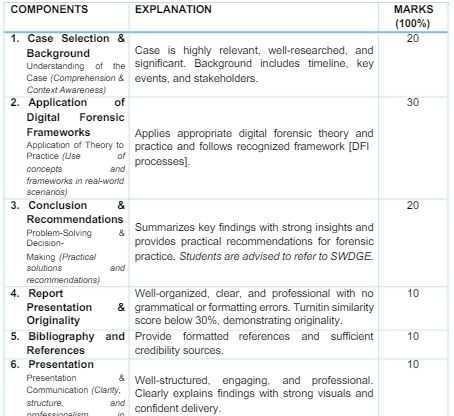
A case study analysis in a digital information forensics course allows students to explore real- world scenarios by applying theoretical knowledge to practical situations. Students are required to identify a real digital information forensics case and displayan analysis based on the guidelines given
Below are the key components and structure for conducting a thorough case study analysis.
Achieve Higher Grades IMR543 Assignment
Order Non Plagiarized Assignment
IMR543 Individual Assignment (10%) – Submission: Week 4
CLO3: Explainrelationship between Forensic Evidence Investigation and Records Management. (A4)
1. Scientific Working Group on Digital Evidence (SWGDE): Article Summary (10%)
Students are required to present and explain ONE (1) best practice/guideline prepared by Scientific Working Group on Digital Evidence (SWGDE) from SWGDE during knowledge sharing session.

Need help with your own assignment?
Our expert writers can help you apply everything you've just read — to your actual assignment.
Get Expert Help Now →